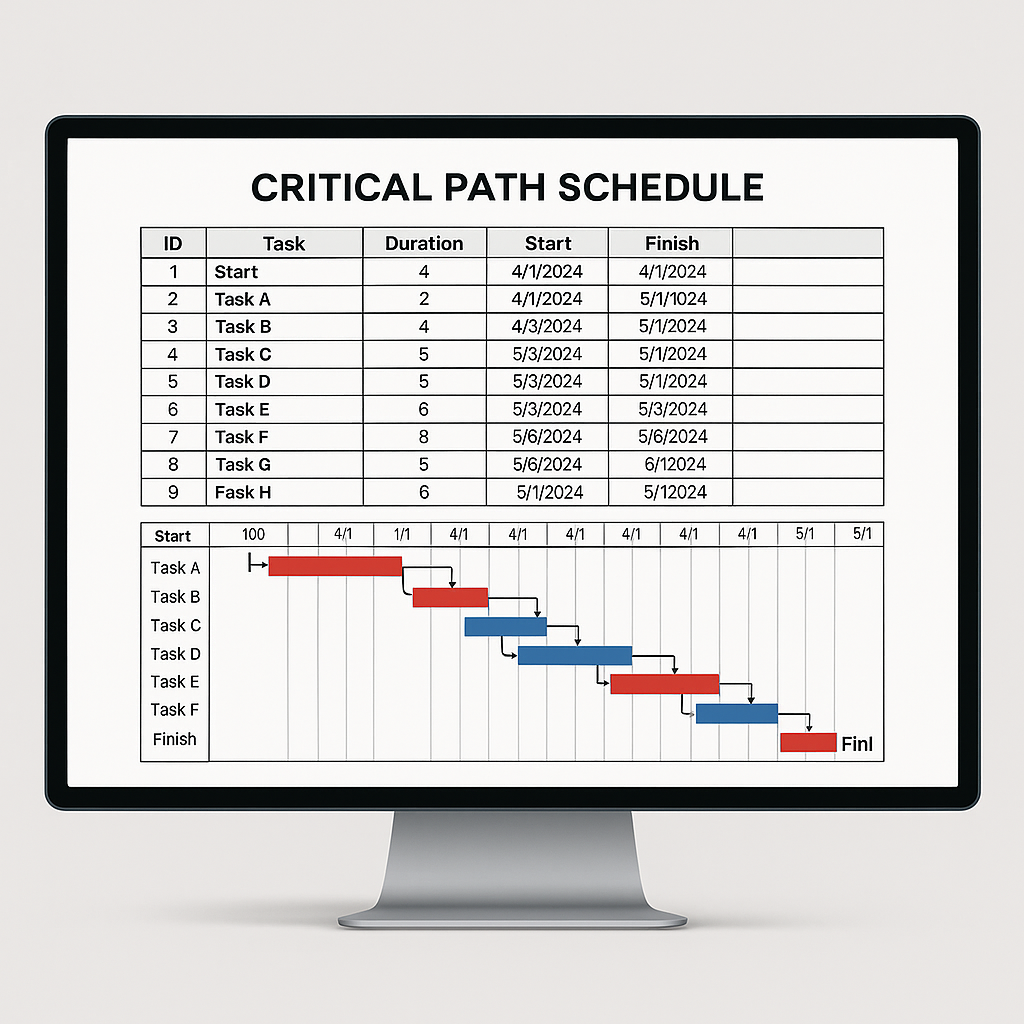
Achieving project success comprises various elements, among which effective management practices play a crucial role. One such practice that has gained prominence among project managers is earned value tracking. This method integrates project scope, cost, and schedule to provide accurate forecasts and insights into project performance. Understanding earned value tracking will help you navigate your projects toward successful completion.
Understanding Earned Value Tracking
At its core, earned value tracking provides a framework for measuring project progress. Unlike traditional tracking methods that might simply look at milestones or completion percentages, earned value tracking quantifies the actual value of work performed at any given point in the project timeline. This allows project managers to get a clearer picture of project health, identify potential problems early on, and make informed decisions.
For example, consider a construction project budgeted at $2 million and scheduled to take 12 months. By the end of month six, the project's earned value is calculated based on how much work has been completed and what it was supposed to cost. If the completed work equals $1 million but costs $1.5 million, the project manager can see there's a significant issue.
Key Components of Earned Value Tracking
The system of earned value tracking relies on three primary components: Planned Value (PV), Earned Value (EV), and Actual Cost (AC). Understanding these allows project managers to gauge their project's performance effectively.
Planned Value (PV): This represents the budgeted amount of work to be completed by a specific time. For instance, if the first quarter of your project is planned to spend $500,000, that's your PV at the end of that quarter.
Earned Value (EV): This indicates the value of work actually performed up to a specific point, expressed as a percentage of the total budget. If you've completed work equivalent to $400,000 worth of the larger $2 million project, then your EV at the end of that quarter is $400,000.
Actual Cost (AC): This reflects the actual expenses incurred for the work accomplished. If you spent $450,000 to achieve that $400,000 worth of EV, then your AC is $450,000.
What Are the Three Basic Metrics of Earned Value Management?
With an understanding of PV, EV, and AC in hand, we can calculate critical performance metrics that inform project progress.
Cost Performance Index (CPI) is a measure of cost efficiency in a project, calculated as CPI = EV / AC. A CPI greater than 1 indicates you're under budget, while a CPI less than 1 indicates you're over budget. For example, if your EV is $400,000 and your AC is $450,000: CPI = $400,000 / $450,000 = 0.89 — suggesting inefficiency, leading you to explore where costs can be reduced.
Schedule Performance Index (SPI) provides insights into how efficiently project time is being utilized, calculated as SPI = EV / PV. An SPI greater than 1 suggests the project is ahead of schedule, while an SPI less than 1 indicates you're falling behind. Continuing with our previous example, if your PV at this point was $500,000, your SPI would be: SPI = $400,000 / $500,000 = 0.80 — indicating a scheduling issue that needs to be addressed.
Variance Analysis involves examining the differences between the planned budget and actual costs or schedule performance. Positive variances are favorable, while negative variances indicate problems that need to be addressed. Cost Variance (CV) = EV - AC, and Schedule Variance (SV) = EV - PV. For our earlier metrics: CV = $400,000 - $450,000 = -$50,000 (indicating you're over budget), and SV = $400,000 - $500,000 = -$100,000 (indicating you're behind schedule).
Benefits of Mastering Earned Value Tracking
Mastering earned value tracking offers numerous benefits to project managers: visibility into project performance, making it easier to identify discrepancies between planned and actual performance; proactive management, with early detection of issues enabling corrective actions before problems escalate; forecasting accuracy, enabling credible forecasts and adjustments as project conditions change; stakeholder communication, offering concrete numbers and analysis for transparent communication and enhanced trust; and resource optimization, identifying inefficiencies to help reallocate resources more effectively and ultimately save costs.
Steps to Implement Earned Value Tracking
Start by defining the project plan — a clear breakdown of scope, schedule, and budget, establishing what constitutes your PV. Establish a baseline that serves as a reference point from which to track progress, with budget and schedule clearly defined. Collect data regularly about actual work completed and costs incurred, timed strategically (weekly, bi-weekly, etc.) depending on the project's workload. Calculate key metrics regularly to assess project health and reveal trends over time. Finally, adjust accordingly, using real-time data to improve your project management process — this may involve re-allocating resources, revising timelines, or communicating changes to stakeholders.
Elevating Your Project Management Skills with Earned Value Tracking
In an era where project management is paramount, mastering earned value tracking can elevate your ability to deliver successful projects. By integrating this method into your project management practices, you not only improve monitoring and forecasting but also empower your decision-making skills. Whether you are managing a small team or a large organization, implementing earned value tracking will provide you with invaluable insights and enhance your overall project management effectiveness.
With the right tools and dedication, you can master this practice and lead your projects toward success. Incorporating these strategies around earned value management will help you identify performance gaps and take actionable steps. Remember, the key to project success lies in the continuous assessment and adjustment of your practices. Take the leap to master earned value tracking, and witness a transformation in your project outcomes.